| |
|
|
|
Beginners
Heraldry -
By Mark Harden of
Cowdenknowes |
|
|
 |
The first point that
should be made about heraldry is that there is no such thing as a
“Family Coat of Arms”. This is a form of marketing used by the
“Heraldry for Sale” bucket shops and websites that are becoming a
common sight, both on the internet and at highland games all over the
world. Armorial bearings, which is a more formal description of a coat
of arms, are, at least in Scotland, the personal property of one
person only. Displaying arms which are not registered to you, or which
you do not have a right to, can lead to prosecution in countries such
as Scotland, where heraldry is carefully regulated. In other countries
you could just look foolish.
In Scotland all things armorial are governed by the laws of arms
administered by the Court of the Lord Lyon. The origin of the office
of Lord Lyon is shrouded in the mists of history, but various Acts of
Parliament, especially those of 1592 and 1672 supplement the
established authority of Lord Lyon and his brother heralds. The Lord
Lyon is a great officer of state and has a dual capacity, both
ministerial and judicial. In his ministerial capacity, he acts as
heraldic advisor to the Sovereign, appoints messengers-at-arms,
conducts national ceremony and grants arms. In his judicial role, he
decides on questions of succession, authorizes the matriculation of
arms, registers pedigrees, which are often used as evidence in the
matter of succession to peerages, and of course judges in cases when
the Procurator Fiscal prosecutes someone for the wrongful use of arms.
|
Arms should not
be used in Scotland unless they are recorded in the Register of
all Arms and Bearings in Scotland. Armorial bearings can be
acquired by petitioning the Lord Lyon, but only if you come within
his jurisdiction (www.lyon-court.com).
However, in England you would approach the College of Arms (www.college-of-arms.gov.uk).
A person who has arms is called
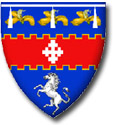
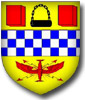
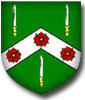
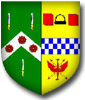
an armiger (figs1 & 3) and his family is considered armigerous.
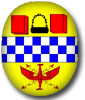
Men bear their arms on a shield and women on a lozenge or more
recently on an oval, although this is not a binding rule. A woman
usually uses her husband’s arms on a shield (fig1) while he is
alive and on an oval or lozenge (fig 2) after his death. A
daughter may also use her father’s arms on an oval or lozenge (fig
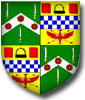
2). If a daughter marries an armigerous man, she may impale her
arms with his (fig 4); the impaled arms are usually displayed on a
shield, but to be absolutely correct the wife would use a lozenge.
If she is an heraldic heiress, that is she has no brothers, her
children may then quarter their father’s and mother’s arms
together (fig 4a). |
|
|
 |
|
fig 1 |
|
 |
|
fig 2 |
|
 |
|
fig 3 |
|
 |
|
fig 4 |
|
 |
|
fig 4a |
|
|
|
|
The next member of an armiger’s
family with a right to bear their father’s arms is the heir; this
is the person who will inherit the arms on the death of the
armiger, usually the eldest son, unless specified otherwise in the
Letters Patent. The heir has the right to use and display the arms
but must display them differenced by a label of three points (figs
5,6 & 7). This label stays on the heir’s arms during the lifetime
of the holder. This shows that he is the heir and that the holder
is still living; the label is simply removed when the heir
inherits. The label can be of any design or colour as long as it
is clearly visible upon the arms. |
|
|
|
|
|
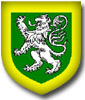
According to the Scottish laws of
heraldry, a younger son has no right to his father’s arms but must
petition to matriculate from those of his father his own arms,
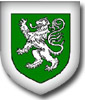
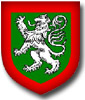
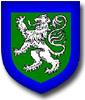
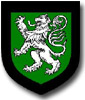
which will be differenced from his father’s. This differencing is
often done with a bordure, according to the Stodart system,
depending on the birth order of the son: the second son would have
a bordure Or (gold), the third Argent (silver), the fourth Gules
(red), the fifth Azure (blue) and the sixth Sable (black). It is
possible also to difference by the addition of a charge, perhaps
from the mother’s arms, or by changing the partition lines from
perhaps straight to, for example, engrailed. |
|
|
 |
|
Bordure
Or |
|
 |
|
Bordure
Argent |
|
 |
|
Bordure
Gules |
|
 |
|
Bordure
Azure |
|
 |
|
Bordure
Sable |
|
|
|
|
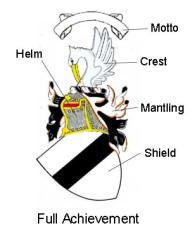
Any descendant may choose to vary
the crest and motto. The original motto would have been chosen at
the time of the grant and might well say something about the
family. The crest, which is mounted on top of the helmet, would
also have done the same but in a symbolic way. Each matriculant
can change these two parts of the achievement to refer to himself. |
|
|
|
 |
|
|
|
As mentioned
earlier, the armorial bearings are the personal property of the
armiger and are protected by law. The arms can be used in many
ways, such as on silver, stationery, cups, T-shirts, badges, caps,
plaques, banners and just about anything else. It is well worth
checking with your heraldic authority before making any banners as
the size of a banner may be regulated. Bearing arms is an honour
and people who bear arms have something to be proud of; armigers
are encouraged to display them in every way they can.
If you have an ancestor who resided in the colonies while your
colony was under the jurisdiction of the British crown, ie prior
to September 1783 for the USA, and you are a descendant in the
male line of that ancestor, then you can petition the Lord Lyon
for a grant of arms in memory of that ancestor and also to
matriculate those arms, suitably differenced for yourself.
My thanks to
Raymond S. Morris of Balgonie and Eddergoll for the use of his and
his family's arms. |
|
|