|
|
|
Scottish Civic
Heraldry - By Mich Taylor |
|
Please Click
Crowns for further pages |
|
|
|
The pages that follow do not try to
tell the full story of eight centuries of Scottish civic heraldry.
All they try to do is set out a record of the coats of arms –
with the ‘additional trimmings’ of helmets and crests, supporters
and compartments, crowns and coronets - of all Scotland’s
councils, past and present, and to add to that record as more and
more councils have arms recorded in the Public Register. The aim
is just to give everyone – from the heraldic enthusiast to the
casual surfer who just happens across these pages - the chance; |
|
|
-
to see
something of Scots civic heraldry’s long past and its active
present,
-
to see
something of its grandness and something of its eccentric
oddities (for a nominally Presbyterian country Scotland has
an awful lot of saints and bishops and abbots in its post
Reformation civic heraldry),
-
to see it’s
golden city crowns and its coloured burghal coronets,
-
to enjoy
the sparse simplicity of some modern arms,
-
and to
wonder at the strange complexities of form and colour that
some civic bodies have chosen for themselves.
|
 |
|
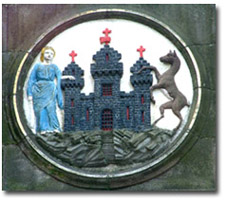
City of
Edinburgh |
|
|
|
Contemporary
Scottish Civic Heraldry |
|
|
|
Scotland’s councils nowadays come in
two kinds, area councils (including city and island councils) and
community councils, but, because of two total upheavals in
Scottish local government within a generation, there is not a
council that dates back before 1975. So modern Scots civic
heraldry is, formally at least, still a young adult. |
|
|
|
 |
|
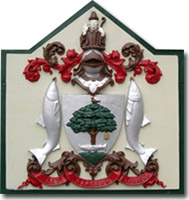
City of
Glasgow |
|
But, however young Scotland’s
civic heraldry may be, it contains coats of arm that are
really quite old , like Dundee’s – in use by the royal burgh
of Dundee certainly as early as 1416, recorded in 1673 for the
royal burgh in the Public Register, ‘regranted’ to the City of
Dundee District Council following the great local government
upheaval of 1975, and ‘re-regranted’ to Dundee City Council
following the great upheaval of 1996. Although the City of
Dundee Council’s bearings are, at the time of writing,
officially just eight and a half years old, the coat on which
they centre will before too long be celebrating its 500th
birthday.
And, of course, Scotland’s
modern civic heraldry contains coats like Heldon Community
Council’s that have yet to celebrate a single birthday. |
|
|
All but two of
the area councils, Aberdeenshire and East Renfrewshire have arms –
some fairly ancient, like Dundee City Council’s, and some almost
brand spanking new like South Lanarkshire Council’s 1997 coat.
|
|
|
|
As for the community councils,
it will probably be a long wait until they all have arms, if
they ever do. After all there were only ever 68 royal burghs
and by the time they were abolished in 1975 there was still
one, that had its origins as a royal burgh in the 13th
century, but that at its end, nearly six centuries on, still
did not have arms! |
|
|
The Lost
Twenty-one Years – 1975 to 1996 |
|
|
|
 |
|
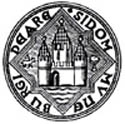
Ayr
Burgh Seal |
|
The twenty one
years between 1975 and 1996 saw the sudden rise and the quick
demise of the regional and district councils – as well as the
birth of the community councils. The regional councils, sort of
mega-counties, were an entirely new creation and so their heraldry
was also an entirely new creation with almost all of it following
a single uniform pattern. The districts were in effect counties
deprived of almost all their historic authority but not of their
geography, which meant that many district council’s arms were
regrants of county ones, though there were some completely new
coats. And, of course there were the community councils which are
still with us and still acquiring arms. |
|
 |
|
District
Councils |
|
|
 |
|
Regional
Councils |
|
|
|
|
The First Seven
Centuries |
|
|
|
The story of the
first seven centuries of Scots civic heraldry is for a long while
the story of burgh heraldry – at first the royal burghs and then
the parliamentary burghs and the police burghs, with the counties
joining in only for for the last couple of centuries – the first
was the county of Roxburgh 1n 1798 - before the whole lot were
abolished in the great upheaval of 1975.
But many of the early coats live on in modern heraldic use: in the
north, Aberdeen’s coat from the 15th century is still in use by
Aberdeen City Council, in the south the coat tussled over by Lord
Lyon and the royal burgh of Jedburgh in the late 1670s is still
seen day by day in modern form on Jethart’s streets and every
summer presides over the Callant’s Festival. |
|
|
|
 |
|
The Burghs |
|
|
 |
|
The Counties |
|
|
|
Crowns, Coronets,
Compartments and Other
‘Additional Trimmings’ |
|
|
|
As well as the pages setting out
Scotland’s civic heraldry council by council, there is a short
account of all the various sorts of, and entitlements to, the
‘additional trimmings’ that have over the centuries surrounded the
actual coats and indeed still do. |
|
|
|
R M Urquhart
These pages simply wouldn’t have
been possible without all the detailed work done over decades
by R M Urquhart and collected together in his three books
that, unlike these few simple pages, really do tell the story
of Scottish civic heraldry through the long continuities of
the centuries and over the discontinuities of the 20th century
upheavals. |
|
|
|
To the Lyon Court –
with thanks |
|
|
|
For the kind and
generous help that has also made these pages possible, especially
in adding to RM Urquhart’s record those bearings that have been
added to Scotland’s civic heraldry since his record ended. |
|
|
|
 |
|
Civic Seal
of Aberdeen |
|