|
|
| |
Scots Heraldry - The Heraldry
Society of Scotland |
. |
| |
|
|
|
Some Distinctive Characteristics of Scots Arms - By Alex Maxwell
Findlater |
|
To look today in the twenty-first
century at a page of new Scottish arms, one would immediately see
the similarity to arms of the mediæval period. This would not be
the case with, for example, new English arms, which tend to be
much more adventurous and thus less traditional.
The reason for this is that in
Scotland we have a system of family arms, whereby almost all arms
granted to the same name are based on the arms of the chief of
that name, even when no blood relationship can be proved. Our
feeling of clan or family is so strong that we automatically
accept the correctness of this approach, which has, of course,
evolved slowly over the centuries.
The major consequence of this is
that we have retained in our arms the traditional mediaeval
charges and patterns of charges. This in its turn has meant that
we have had to devise a system for differencing these newer arms
from those of the chief. This is further complicated by the
Scottish doctrine that one coat of arms can be borne by one man
only. |
|
|
|
DIFFERENCING |
|
|
|
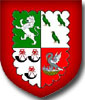
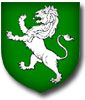
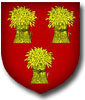
In the earliest mediaeval days,
differencing was often achieved by a change of tincture. Thus
Home, which was a cadet of March (Dunbar), derives from March by
substituting a green field for the red of March. Again we know
that the senior line of the ancient Comyns, Comyn of Badenoch,
bore a red shield, while the cadet line of Buchan, ancestors of
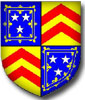
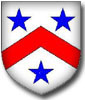
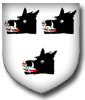
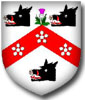
modern Comyns, changed their tincture to blue. The chevron was
also often introduced into a coat as a difference, eg Brodie
(probably) from Innes and certainly in the case of Nisbet of
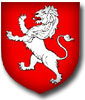
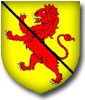
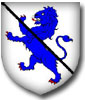
Dirleton. Also a bend or ribbon, a thin bend, across the shield
over all the charges was often adopted by a younger son, such as
Sir John Lyon of Glamis, before he was allowed the double tressure,
and the lords of Abernethy, who were descended from the earls of
Fife. |
|
|
 |
|
March |
|
 |
|
Home |
|
 |
|
Comyn of Badenoch |
|
 |
|
Comyn of Buchan |
|
 |
|
Abernethy |
|
|
 |
|
Innes |
|
 |
|
Brodie |
|
 |
|
Nisbet |
|
 |
|
Nisbet of Dirleton |
|
 |
|
Lyon |
|
|
|
|
These differences
by tincture, or by the addition of ordinaries such as the chevron
and ribbon were perhaps sufficient in early mediaeval times.
However, as the number of armigers became greater, and because
each armiger had to have his own distinctive, and thus
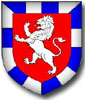
differenced, arms, there developed the use of bordures to act as
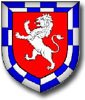
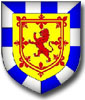
differences. For example a bordure compony, ie of one row of
alternating blue and silver squares. often elongated, slowly
became a mark of bastardy, but was not so originally, eg Wallace
of Ellerslie, from whom the famous Sir William Wallace sprang.
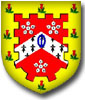
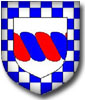
The bordures themselves were often dimidiated or even quartered
and various lines of partition were used, so that the inside of
the bordure might be engrailed or wavy. |
|
|
|
 |
|
Wallace of Ellerslie |
|
 |
|
Wallace of Ellerslie |
|
 |
|
Lundin
of that Ilk |
|
|
|
|
Wallace of
Ellersley: originally compony but changed in 18c. as compony
had come to represent bastardy. |
|
|
 |
|
Hamilton of
Bedhouse |
|
|
 |
|
Carmichael
of Blackburn |
|
|
|
In the last century a complicated
system of differencing by bordures was propounded by Stodart to
allow for cadet arms, but although it gives a conceptual
framework, this has in practice been more honoured in the breach
than in the observance. |
|
|
|
MARSHALLING OF
QUARTERS |
|
|
|
Another way in
which Scots arms differ from those of England in particular, is
that in England another quarter will be added to the shield when
another heiress brings her arms into the family, giving the
possibility of quarterly of six (if there are only five coats to
be marshalled the first quarter is repeated), quarterly of eight,
nine, ten, twelve or indeed any number which will geometrically
fit within the shield. This can give rise to arms of the most
extreme complexity, which can be seen in the book Armorial
Families by Fox-Davies. |
|
|
|
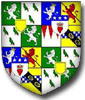
In Scotland, this potential for
confusion is contained by the use of Grand Quarters. Thus if a man
with each of his four quarters occupied by a different coat
marries an heiress, he has to either abandon one of his existing
quarterings and substitute hers for it, or else place his arms in
the first and fourth quarters, which now become Grand Quarters and
place his wife’s arms in the second and third quarters. If she
already has quartered arms, then these will also be Grand
Quarters. The only variant to this is that if there are five coats
to be born, the paternal arms may be borne on a inescutcheon, or
if there is a quarter which has been granted as an honourable
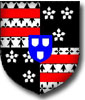
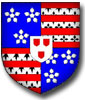
augmentation, this may be placed on the inescutcheon. The two
versions of the Hay of Yester, later of Tweeddale show how arms
can be changed over time. The same basic arms are retained, but
order of the quarters have been changed and also the tinctures to
conform to those most commonly met with in the Fraser and Hay arms
respectively. |
| |
|
 |
|
Home |
|
| |
|
 |
|
Hay of Yester
|
|
| |
|
 |
|
Tweeddale |
|
|
|
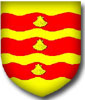
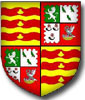
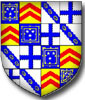
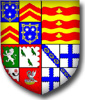
The most unusually complex arms of
the family of Stirling-Home-Drummond-Moray of Abercairney show how
this marshalling happened in only two generations. In the first
generation Henry Home of Kames, Lord Kames as a senator of the
Court of Session, married Agatha Drummond, eventual heiress of
Blair Drummond. Their issue George Home Drummond took the name
Drummond and quartered Drummond in the first and fourth quarters
with the already quartered arms of Home, which were in the second
and third quarters, thus creating grand quarters. In the same
generation, Charles Moray of Abercairney married the elder
daughter and heiress of Sir William Stirling of Ardoch, Bart.
Again, these arms were both quartered already, so that they made
grand quarters, Moray with its quartering of Strathearn in the
first and fourth and Stirling with its quartering of Sinclair of
Herdmanston in the second and third. In the next generation
George Home Drummond of Blair Drummond married Christian eldest
daughter and heiress of Charles Moray. Again in this case, the
name Moray ousted Drummond, despite the equal antiquity of that
name, so that their issue bore the name Moray as their principal
surname and the Moray arms went in the first grand quarter.
Drummond, unquartered, went in the second, Home, with it four
different quarters all within the bordure engrailed Gules for a
second son went in the third and Stirling, although a baronetical
name, went with its Sinclair quarter in the fourth. |
|
|
|
|
|
 |
|
Drummond
of |
|
Blair Drummond- |
|
|
|
|
|
|
 |
|
|
Married |
|
Agatha Drummond |
|
heiress of
|
|
Blair Drummond |
|
|
|
|
 |
|
Charles Moray |
|
of Abercairney |
|
- |
|
Married |
|
Eldest
daughter |
|
and heiress of |
|
Sir William
Stirling |
|
|
|
|
|
 |
|
George Home
Drummond |
|
of Blair
Drummond |
|
- |
|
- |
|
Married |
|
Christian
eldest daughter |
|
and heiress of |
|
Charles Moray
of |
|
Abercairney |
|
|
|
|
|
|
Next Page |
|
Page; 1 2
3
4 |
| |
|
|
|
|
© The Heraldry Society of
Scotland last Update
27 Oct 2021 |
|