|
|
| |
Scots Heraldry - The Heraldry
Society of Scotland |
. |
| |
|
|
|
Some Distinctive Characteristics of Scots Arms
- By Alex Maxwell
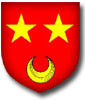
Findlater |
|
We
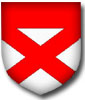
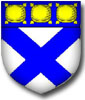
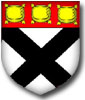
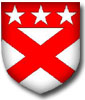
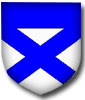
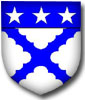
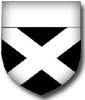
should also note the occurrence of geographical families of arms,
so that in the south west we often find the saltire combined with
a chief, a combination which is peculiarly Scottish and rarely
occurs elsewhere in European arms, derived from the famous arms of
Annandale, which the Bruces adopted. Alongside Bruce we find
Kirkpatrick, Johnstone, Jardine, Boyes, Murray of Cockpool and
Moffat. |
|
|
|
 |
|
Bruce |
|
 |
|
Kirkpatrick |
|
 |
|
Johnstone |
|
|
 |
|
Jardine |
|
|
|
 |
|
Boyes |
|
|
 |
|
Murray of Cockpool |
|
|
 |
|
Moffat |
|
|
|
|
|
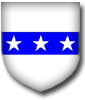
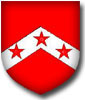
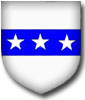
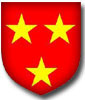
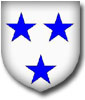
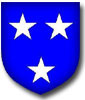
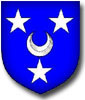
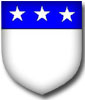
In
the north east lowlands, we see many sets of three stars, as in
Innes, Murray, Sutherland, Brodie, Kirkcaldy. From these may
derive arms no longer associated with that area, such as Douglas,
Mure, Weir, Kerr, in each of which the stars are placed on an
ordinary, also Arbuthnott. |
|
|
|
 |
|
Sutherland |
|
|
 |
|
Innes |
|
|
 |
|
Murray |
|
|
 |
|
Arbuthnott |
|
|
 |
|
Douglas |
|
|
|
|
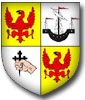
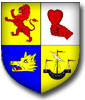
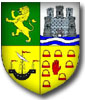
Then
again in the Celtic arms, mentioned above, which are almost all
found in Argyll and the western isles, we find four quarters
combined, not to show dynastic inheritance, but rather symbolic
associations. These quarters usually include a rampant lion, a
lymphad (or galley), a hand holding a cross, a salmon swimming,
and a castle. The symbolism is usually said to be as follows. The
lion represents the royal house of Dalriada, from which the
Scottish and British royal houses descend; the lymphad is
associated with the lordships of the Isles and of Lorne (and thus
adopted by the Hamiltons); the cross held in a hand represents
the kindred of St Columba; the salmon is symbolic in Irish and
Scottish mythology of the wisdom of the king. In Irish prehistory
the salmon pools of a defeated king were ritually destroyed. These
Celtic arms often have more than one charge in a quarter, as eg in
Farquharson. They are treated as indivisible, thus the four
quarters can only be transmitted as a unity. |
|
|
 |
|
McDougal |
|
 |
|
Macintyre |
|
 |
|
Macintosh |
|
 |
|
MacNeil |
|
|
|
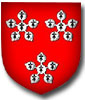
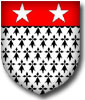
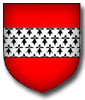
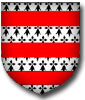
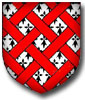
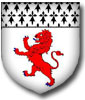
Another Scottish characteristic is the comparative rarity of
furs, so that we see ermine only occasionally, as in Hamilton,
Douglas of Hawthornden, Crawfurd, Fotheringham, McCulloch, and
in the famous chief of Moncrieff. Vair, so common in English
mediaeval arms, hardly appears at all, and other less common
furs even less so. |
|
|
 |
|
Hamilton |
|
|
 |
|
Douglas of Hawthornden |
|
|
 |
|
Crawfurd |
|
|
 |
|
Fotheringham |
|
|
| |
|
 |
|
McCulloch |
|
|
 |
|
Moncrieffe |
|
|
|
|
|
Next Page |
|
Page;
1 2 3 4 |
|
|
|
|
© The Heraldry Society of
Scotland last Update
27 Oct 2021 |
|