|
These
notable clans descended from Anrothan are located in
Cowal, a district which has never come under the aegis
of the Lords of the Isles. This would appear to upset
the theory that use of West Highland Heraldry was
connected with membership of the Council of the Isles. |
| |
 |
|
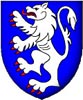
Lamont
|
|
 |
|
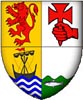
MacLachlan
|
|
 |
|
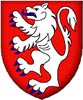
Gilchrist
|
|
 |
|
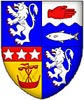
MacSorley
|
|
|
 |
|
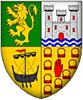
McNeill
|
|
 |
|
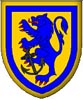
MacNeil
|
|
 |
|
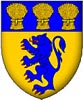
Maclay
|
|
 |
|
MacEwan
|
|
|
|
|
|
The
Maclays/ MaeDunsleaves/ Livingstones and the McEwens |
|
|
Their
arms admittedly are relatively modem but the Border
McEwens of Bardrochat claim descent from the MacEwans
of Otter on Loch Fyne another of the clans descending
from Anrothan as are the MacDunsleaves or Maclays. |
|
|
|
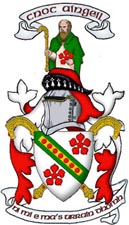
These
latter turn up again in a remarkable fashion as the
Livingstones of Bachuil in Lismore. The strange choice
of Livingstone as an anglicisation may be due to a
Livingstone given a nineteen-year lease of Lismore by
King Charles I in 1641 and the modem arms are clearly
derived from the lowland earls of Callendar rather
than the holder's Highland lineage which is perhaps a
pity, handsome as they are, with the notable
distinction of two croziers crossed in saltire behind
the shield. These represent the Bachuil or Staff of
Saint Moluag, contemporary of Columba, whose seat was
in Lismore, later seat of the Bishopric of Argyll. The
ancestors - presumably in the female line of the
Livingstones, as they now are were given the lands of
the same name for their role as dewars or keepers of
the Saint's staff which they still possess. |
|
|
Even though of minor extent their possessors have
been ranked as Barons of Argyll. Of further
interest is the reference to the representative of
the family of the day who, in 1544 was Iain
McMolmore Vic Kevir, who is addressed in the
charter by the Earl of Argyl as "nostro signifero
" . The late Lord Lyon Sir Thomas Innes of Learney
opined that the word signifer here meant "Pursuivanf'
and that the Keeper of the Bachuil was Argyll's
Officer of Arms, Sir lain Moncreiffe going so far
as to suggest he went by the title of Lorne
Pursuivant. On the other hand Bruce is known to
have summoned both the Keepers of the Brecbennoch,
the shrine of the relics of Saint Columba and of
the Quigrich, the staff of Saint Fillan, to be
borne in the van of the Scottish Army at
Bannockburn and personally, I have little doubt
that the Bachuil was borne into battle by its
signifer or, to use the normal translation of the
word, its "standard-bearer" as an encouragement to
the forces of Argyll, and before that, of the
Lords of Lorne. As a matter of fact there is
one earlier example of Highland Livingstone
heraldry in the district - in Kilcolmkill
churchyard, in Morvern, where an 18c tombstone
displays a quartered coat which includes the lion
rampant. |
|
|
|
|
The
Clan Chattan |
|
|
The
Clan Chattan are also users of West Highland heraldry
although at first sight they are geographically
unlikely to be so. They are in fact a confederation of
families from different sources. The original Clan
Chattan itself is given various origins although the
one favoured by the family itself is that which
derives them from a 11c Gillechattan - Servant of
Saint Cattan whose name appears in various locations
including that of Ardchattan Priory on Loch Etive in
Argyll. From a younger son of this line came the
Macphersons. |
| |
|
The
heiress of the senior line, one Eva, is said to have
married Angus Mackintosh - son of the Thane - said to
have been of Royal lineage as a descendant of the earl
of Fife. From them descend the Shaws and the
Farquharsons and others while yet other unconnected
clans like the Macleans of Dochgarroch and the
MacGillivrays attached themselves to the
confederation. The earliest recorded Mackintosh
seal is that of 1467 which quarters the lion rampant (contourne)
with the galley. This is repeated in 1490 and 1505,
before, in 1543, quarters displaying a boar's head and
the Hand are added. This last is the same as the arms
of today except that from 1680-7 the hand has clasped
a heart. |
|
|
The
early seals of the Chiefs of Macpherson and
MacGillivray both display single charges; a Lion
rampant for Macpherson in 1535 and a stag's head
cabossed for MacGillivray. Both later appear to have
taken a gold galley on blue with a gold chief with on
it, for Macpherson a red Hand holding an upright
dagger and a cross crosslet fitchee and MacGillivray
the stag's head in black with red horns, between two
similar crosses, this time in black. |
| |
|
Gillechattan is claimed to have descended from Loarn;
Angus Mackintosh from the marriage of Crinan, lay
Abbot of Dunkeld, who was of the kindred of Saint
Columba, with Bethoc whose line went back to Kenneth
MacAlpine. So if these claims are correct, the
Mackintosh Chiefs of Clan Chattan had plenty of West
Highland connections. |
| |
|
But
the tales are not unquestioned; may there not have
been a connection with the Pictish tribe of the Catti
from Caithness whose wild cat is used so extensively
as a crest by members of the confederation.
Another possible connection is that the Lord of the
Isles was styling himself Lord of Lochaber and in 1447
made Mackintosh Bailie of his Lordship there. |
| |
|
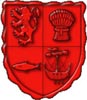
Once
again we seem to be back with the Lordship of the
Isles and its Council. Incidentally, much is
made today of the Clan Chattan Galley being blue
rather than black. I am pretty sure this derives from
the difficulty known to have been experienced in early
times in producing a black pigment that would last.
There are several cases I have come across where a
coat which should be sable is rendered as azure. |
|
 |
|
Cahan
|
|
 |
|
O'Donnell
|
|
 |
|
O'Donnelly
|
|
 |
|
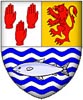
O'Neill
|
|
|
 |
|
MacLoughlin
|
|
 |
|
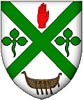
MacKeown
|
|
 |
|
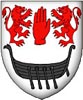
MacHugh
|
|
 |
|
O'Flaherty
|
|
|
|
|
|
Summary |
|
|
So
where are we left ? - Given the spasmodic nature of
the evidence we lack as good a picture as we might
wish for BUT. |
| |
|
(a)
There appears to be widespread use of this form of
Heraldry in the north west on either side of the North
Channel. |
|
|
(b) But the usage is by
no means universal. |
|
|
(c) It is in frequent
use by those connected to the Lordship of the Isles. |
|
|
(d) But by no means
universally so - some Council Members do not use it;
some not on the Council do. |
|
|
(e) Clearly there is no
single blood line involved. |
|
|
(f) But there is an
identifiable totemic reference to several. |
|
|
(g) In several cases
there is evidence of the earlier use of single charges
later replaced by a quartered coat. |
|
|
(h) Most, but not all
usage of quartered coats occurs after the Forfeiture
of the Lordship of the Isles in 1491. |
| |
|
There
are two main questions - "What is the significance of
the four charges?" and "What led to the adoption of
this distinctive form of Heraldry?" We are
reasonably happy with the origins of the Lion, the
Galley and the Hand but the meaning of the Salmon
remains a mystery. |
|
|
Whatever it is, I would suggest that it is a reference
to something very ancient and that it is a reference
to a specific person or dynasty rather than to an
abstract idea. As to the adoption of West
Highland heraldry one is drawn to the Forfeiture and
breakup of the Lordship even though some of the usage
appears to predate it. |
|
|
Can
the users be putting out a message that they have the
necessary qualifications of birth to assert their
position after the disappearance of the former
dominant power in the area - perhaps even in some
cases staking a claim to taking over the leadership
itself ? But the Irish, as ever, remain a
problem. |
| |
|
St
Andrews Day Lecture, 1996 |
|
|