|
|
| |
Scots Heraldry - The Heraldry
Society of Scotland |
. |
| |
|
|
| |
West Highland Heraldry -
The Meanings
| |
|
The MacLeans |
| |
|
The Macleans were
also users of West Highland Heraldry. But their bloodline was very
different from that of the sons of Somerled so it cannot be that
which involves this usage. They were of DaIriadic origin,
descending from the tribe of Loarn through the splendidly named
Old Dougall of Scone and, it would appear, coming back to Argyll
from Galloway. |
|
|
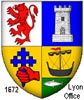
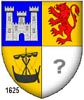
Both Maclean
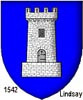
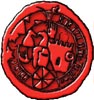
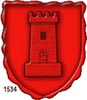
Chiefs early used the device of a tower, shown on a Duart seal of
1534 and, silver on blue, for Lochbuie in Lindsay of the Mount's
1542 Armorial. This was kept as his device by Lochbuie whose arms
of 1672 are recorded in Lyon Office where it appears as a quarter
along with the Galley, the Lion, the Salmon and Hand holding the
Cross. |
|
|
|
|
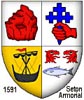
The tower
concerned is surely Lochbuie's castle of Moy. The Seton Armorial
of 1591, however, displays different arms for Duart which are
still in use today. The first quarter contains a rock, not a
castle. I suspect this is the fortress of Cairnburgh in the
Treshnish Isles to which the Macleans retired when Duart became
untenable. As well as the Hand and Cross, the Galley and the
Salmon they have two eagles' heads respectant which I believe may
be a depiction of the Hawks which were, as the Exchequer Rolls
reveal, supplied to the King on various occasions by the Maclean
Chiefs. |
|
|
|
The earliest
recorded seal of the Chief of Duart is something of a surprise
since the actual shield shown has on it the familiar gyronny of
eight of the Campbells. Grouped around it are, however, the Tower,
the Hand. the two Eagles' Heads and the Galley. The later enmity
between the two clans has tended to hide the fact that in earlier
days they were in fact good friends. Hector Mor of Duart whose
seal this is was a staunch ally of the Campbell Chief and became
his father-in-law. This seal is a clear political statement.
If the Macleans were of different blood they were for long
followers of the Lords of the Isles and sat on the Council of the
Isles. Could this perhaps provide a common link? |
|
|
 |
|
Seal
|
|
 |
|
Sir Robert Lindsay II
|
|
 |
|
Herald's Roll
|
|
 |
|
Duirinish Cup
|
|
|
 |
|
Gourd
|
|
 |
|
Tomb
stone |
|
 |
|
Lyon Office
|
|
|
|
|
|
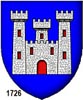
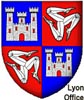
Although
previously listed among those not using this form of heraldry
a closer look is interesting. The earliest Macleod of
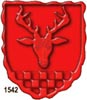
Macleod seal on record in 1542 displays a stag's head cabossed
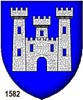
with a chequy base. This is followed by Sir David Lindsay, yr,
in 1582 who shows Macleod with a triple-towered castle, silver
on blue. This was confirmed by Lyon in 1726 and is now now
quartered with the triple-legged device of the Isle of Man,
silver on red. |
|
|
|
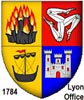
This is
because the Macleods imagined themselves descended from King
Olaf of Man (whose device, as we have already noted, would in
fact have been the Galley). More recent research has shown
that although certainly Norse in origin, the Macleods do not
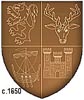
descend from this monarch. But three 17c examples in
fact show the Macleod chiefs using West Highland heraldry; a
cup from Duirinish which belonged to Sir Rory Mor and a gourd
at Dunvegan display quartered coats where the castle and the
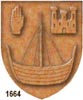
stag's head are joined by the lion and the galley. Sir Rory's
1664 tombstone has a Galley on it, accompanied, in chief, by
the hand and the castle. |
|
|
|
|
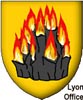
The
Macleods of the Lewes have very different arms - a
black burning mountain on a gold field. The
explanation of this mystery has, I am convinced, been
identified by David Sellar, who has pointed out that
Macleod of the Lewes obtained most of his lands
through marriage with the heiress of the Nicolsons of
Portree and probably took her arms as well. Not only
were the Nicolsons supposed to hold their lands from
the Norse rulers of the Isles for their services as
coastwatchers - hence the burning mountain - but the
recent imbroglio can be explained in which Nicolson of
Scorrybreac was less than happy when it became evident
that his arms as accepted by an unobservant
predecessor displayed his subordinate status to Lord
Carnock who had been granted Arms as Chief of the Name
of Nicolson. |
| |
 |
|
Macleod
of Cadboll
|
|
 |
|
Macleod
of the Lewes
|
|
 |
|
Macleod
of Macleod
|
|
|
|
|
The
Camerons |
|
|
Also
listed among the non-users were the Camerons of
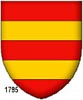
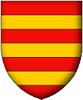
Locheil whose gold and red barry coat is a famous one. |
|
|
|
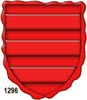
This
coat appears in the Ragman Roll in 1296, the oath of
Allegiance sworn to King Edward I of England by most
of the Scots nobility. It is of geographic origin, the
name appearing in several places in Scotland, notably
in the parish of that name in Fife. Mrs. Beryl Platt
has put forward a strong case for the name originating
in Cambrun in Flanders where the arms of Oudenarde
appear to be the same. |
|
|
Whether
a young man of this house ever came north and married
the heiress to the Lochaber group of clans which took
Locheil as their chief is problematical. Cam shron or
'Crooked Nose' as a personal nickname seems a more
likely source but the Locheil family have long used
the arms of the lowland Camerons (Lyon first granted
them, it is true, with only two gold bars instead of
the present three, in 1795). |
|
|
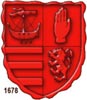
But
they did have doubts, as a document at Inveraray
reveals: there Locheil's seal of 1678 is a quartered
one with the barry coat in the third quarter, the
first, second and fourth displaying a Galley, a Hand
and a Lion Rampant respectively. And certainly
the composition of the Council of the Isles must
surely have varied; the Camerons of Locheil would have
certainly been contenders for membership. |
|
|
|
|
|
|
|
|
|
|
|
|
|
© The Heraldry Society of
Scotland last Update
27 Oct 2021 |
|